|
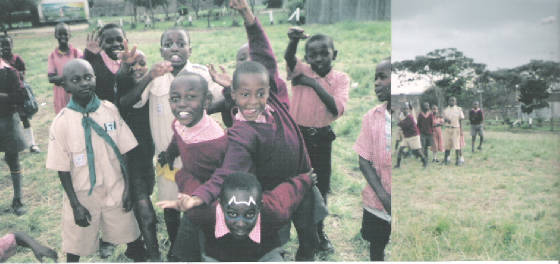
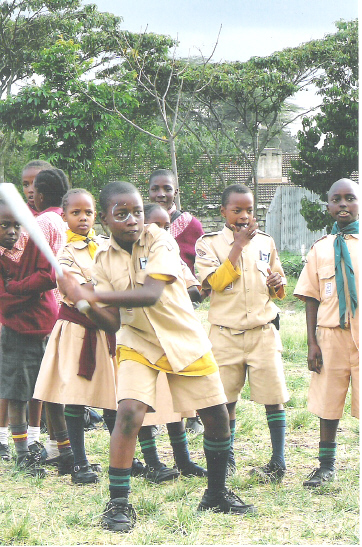
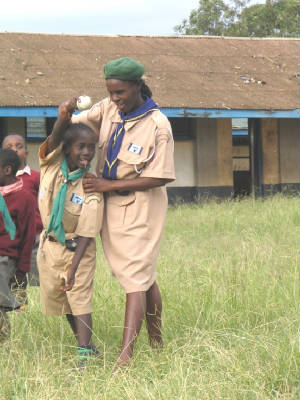
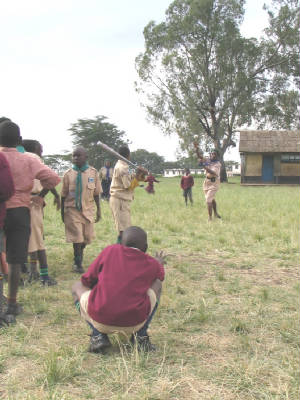
| KENYAN BOYS PLAY FOR THE CAMERA, AND PLAY BALL |
|
|
| THE KIMATI PRIMARY SCHOOL IN NAIROBI LACKS EQUIPMENT, BUT NOT ENTHUSIASM |
Of Kenya's eight provinces, five are playing
baseball. The program began in 1992, and since then a group of Kenyans has played in Japan three times, and also in Europe.
Nairobi has about 1,000 youths participating; Mombasa, 400; and Meru, 200. Baseball is also being taught through the sports
department at Kenyatta University to students. The schools are active are January-March and May-July. But problems persist.
"It's not growing because we do not have (enough) equipment," explained Salomon Gacece, executive secretary
of Kenya's youth and sports commission. "There is interest. We see a lot of talent. We just need to train the skills
on fielding and running. We're still at a zero point. Our priority is equipment and fields."
The Kenyans
have a goal of teaching the teachers how to teach baseball to grow the sport. Kenyan adults, more than almost any other African
nation, are more taken to Western culture, including baseball.
"My aunt told me it was the best game so when
she takes me to school, I start to play baseball," said Winston Omondi, 11, who admires Roger Clemens. "I like baseball
because it's a new game. Soccer is an old game."
Added 10-year-old catcher Sylvester Okumu: "My father
bought me a baseball when I became number one in my class. I like to catch and I like to hit."
A group of
two dozen young boys and girls took turns hitting one of two baseballs delivered by their teachers, Nelly Awoko and Terry
Wandie. As nightfall set on Eastland, a particularly rough section of Nairobi, the teachers gathered the group together.
Suddenly, one-by-one the youths began to touch my arm. At first, I felt threatened. What was going on? Why weren't the teachers
trying to stop them? Then I saw into the eyes of Awoko, Wandie, the taxi driver – and the children.
"They'll go home tonight and tell their parents they touched the skin of a white man for the first time," the
cab driver tells me.
After getting felt up by more than two dozen Kenyans, I felt weird –and I guess
a bit like a rock star. As I had done in Uganda, I spoke to the children and encouraged them to work hard in school, stay
out of trouble – and play more baseball. When I had finished my impromptu speech, one boy asked me a question
in a soft tone.
"Can you bring us some more equipment so we can play?" the boy asked.
I
said I would do my best. It occurred to me that the Kenyans, like their continental neighbors to the north, south, east and
west, just want to play ball.
|